 Weeklo
Study Schedule for Exams: 3 Worked Weeks (Free Printable)
Build a study schedule for exams with three worked weeks (8, 4 and 2 weeks out), a re-plan for falling behind and a free printable week page in A4 and Letter.

Key takeaways
- A study schedule for exams needs four things: your exam dates, a topic list per subject, study blocks with start and end times, and one buffer block a week.
- Count the weeks left. Start from the 8-, 4- or 2-week example below and copy the pattern: learn first, practise later.
- Early weeks are for covering topics. The last two weeks are for timed past papers, marking and fixing errors.
- If you fall behind, keep the learning blocks, merge duplicates and push practice to next week. Do not double up.
- Free printable study week page below, A4 and US Letter, dated November 2026 to June 2027.
In this article
- How to make a study schedule for exams in 6 steps
- How the weeks change as exams get closer
- Example 1: eight weeks to exams
- Example 2: four weeks to exams
- Example 3: two weeks to exams
- The final exam study schedule: the last three days
- What to do when you fall behind
- Free printable study week page (A4 and US Letter)
- Make your study schedule in Weeklo
A study schedule for exams is a dated plan that gives every subject its own study blocks with a start and end time, and shifts from learning topics to practising past papers as the exam gets closer. To build one, write down your exam dates, count the weeks you have left, and copy the pattern of the matching example week below. You will find worked weeks for 8, 4 and 2 weeks before your exams, a plan for when you fall behind, and a free printable week page.
How to make a study schedule for exams in 6 steps
Give yourself 30 minutes to set this up, then 10 minutes a week to adjust it.
- Write down every exam date and count the weeks. The number of weeks left tells you which example week below to start from.
- List the topics in each subject. Use the syllabus, lecture titles or the contents page of your notes. Mark each topic green, yellow or red for how well you know it. Red topics get the first and the longest blocks.
- Block your fixed commitments first. Classes, work, meals, prayer or exercise times, travel and sleep go in before anything else. What is left is your real study time. This is the same order we use in our guide to time block planning.
- Add study blocks of 60 to 120 minutes, each with one job. “Chemistry: acids and bases, notes plus questions” gives you something to start on. A block named “Study” does not. Begin with two or three blocks a day, with a break between them, and add more only when you keep finishing them.
- Move from learning to practising as the exam gets closer. Early weeks cover each topic for the first time. Later weeks are for past papers, marking and fixing mistakes. A 2013 review of ten study techniques in Psychological Science in the Public Interest (Dunlosky and colleagues) rated practice testing and spreading study sessions over time both high-utility, and rereading and highlighting low-utility.
- Add a buffer block, a rest day and a weekly review. A two-hour catch-up block on Saturday absorbs the session that ran over. A rest day keeps the plan sustainable. A 30 to 60 minute review on Friday shows you what to move into next week.
How the weeks change as exams get closer
The job of a week changes with the distance to the exam. This table is the whole plan in short, and the next three sections show a full week for the first three rows.
| Weeks to exams | Main job | What a block looks like |
|---|---|---|
| 8 or more | Map every topic and start learning | Notes on one topic, plus a few practice questions |
| 4 to 7 | Cover every topic once, start past papers | Topic blocks, one timed past paper a week |
| 2 to 3 | Practise, mark, fix errors, shore up weak topics | A timed paper followed by a marking block |
| The last week | Light review and logistics | Short recall sessions from memory |
The examples assume three exams: Physics, Chemistry and History. Swap in your own subjects and keep the pattern. Times are written 24-hour style, so 16–17 means 4 to 5 pm.
Example 1: eight weeks to exams
At this distance you probably still have lectures, so study blocks sit in the evenings and at the weekend. The goal of the week is to know exactly what you have to learn and to start on the first topics.
| Day | Study blocks |
|---|---|
| Mon | 17–18:30 Physics: list every topic, mark gaps |
| Tue | 17–18:30 Chemistry: list every topic, mark gaps |
| Wed | 17–18:30 History: list the themes and dates to know |
| Thu | 17–18 Physics: first topic, notes plus a few questions |
| Fri | 17–17:30 Weekly review, plan next week |
| Sat | 10–12 Chemistry: first topic · 14–15:30 History: first theme |
| Sun | Rest |
That is about 9 hours of study. Eight weeks out, a complete topic list and a plan you can repeat beat a heroic first week.
Example 2: four weeks to exams
With lectures finished, the mornings open up. Each day gets three blocks, and the subjects rotate so none goes untouched for long. One law-school study blog suggests never going more than three days without reviewing a subject. Treat that as a general rule; the rotation below touches each subject several times a week.
| Day | Block 1 | Block 2 | Block 3 |
|---|---|---|---|
| Mon | 9–11 Physics topics | 11:30–13 Chemistry topics | 16–17 History themes |
| Tue | 9–11 Chemistry topics | 11:30–13 History themes | 16–17 Physics questions |
| Wed | 9–11 History themes | 11:30–13 Physics topics | 16–17 Chemistry questions |
| Thu | 9–11 Physics past paper | 11:30–13 Mark it, list errors | 16–17 Chemistry review |
| Fri | 9–11 Chemistry past paper | 11:30–12:30 Weekly review | Free |
| Sat | 10–12 Catch-up block | ||
| Sun | Rest |
That is about 23 hours of blocks. Thursday and Friday start the past papers: one timed paper, then a block to mark it and write down every mistake. The list of mistakes becomes next week’s topic blocks.

Example 3: two weeks to exams
Two weeks out, most blocks become timed practice followed by marking. The week has fewer hours than the four-week example because timed papers are more demanding.
| Day | Block 1 | Block 2 | Block 3 |
|---|---|---|---|
| Mon | 9–10:30 Physics past paper, timed | 10:45–12 Mark it, fix errors | 15–16:30 Chemistry questions |
| Tue | 9–10:30 Chemistry past paper, timed | 10:45–12 Mark it, fix errors | 15–16:30 History: plan two essays |
| Wed | 9–10:30 History essay, timed | 10:45–12 Mark against your notes | 15–16:30 Physics: weakest topic |
| Thu | 9–10:30 Chemistry: weakest topic | 10:45–12 Recall Physics formulas from memory | 15–16:30 History essay, timed |
| Fri | 9–10:30 Mixed questions, all three | 10:45–11:45 Weekly review, plan the last week | Free |
| Sat | 10–12 Catch-up block | ||
| Sun | Rest |
That is about 21 hours. If a paper takes longer than your block, time one section of it and finish the rest in the next block. Past papers for your own course make the best material; ask your teacher or check your course page if you cannot find them.
The final exam study schedule: the last three days
The last days of a final exam study schedule are lighter than the weeks before. Cover no new topics. Use short blocks to recall your weakest topics from memory, check the time, place and allowed materials for each exam, and write tomorrow’s plan the evening before. The University of Pittsburgh’s Study Lab seven-day test prep plan ends the same way, with a brief review the day before and a good night’s sleep.

What to do when you fall behind
Every study schedule breaks at some point. When a day goes missing, rewrite the plan from today instead of carrying the gap forward.
- Count what is left. How many blocks do you have before each exam? Put today’s date on the page and work forward from there.
- Rank what you missed. Order the missed topics by exam date first and by how weak you are on them second.
- Keep the learning blocks. A topic you have never opened comes before a second round of practice questions.
- Merge and postpone. Two short blocks on the same subject become one. Practice blocks move to next week’s plan.
- Use the buffer. The catch-up block exists for this. Do not add hours at night to cover the gap.
- Rewrite the week and move on. Write the new plan out, cross out the old one, and start from the next block.
Here is the four-weeks-out week again after Tuesday and Wednesday were lost to other commitments. Nine hours of blocks disappeared.
| Missed block | New place |
|---|---|
| Tue Chemistry topics (9–11) | Fri 9–11 |
| Wed Physics topics (11:30–13) | Fri 11:30–13 |
| Tue and Wed History themes | Merged into one block, Thu 16–18 |
| Wed Chemistry questions | Sat 10–12, in the catch-up block |
| Tue Physics questions | Next week’s plan |
| Thu Chemistry review, Fri Chemistry past paper | Pushed to next week |

Free printable study week page (A4 and US Letter)
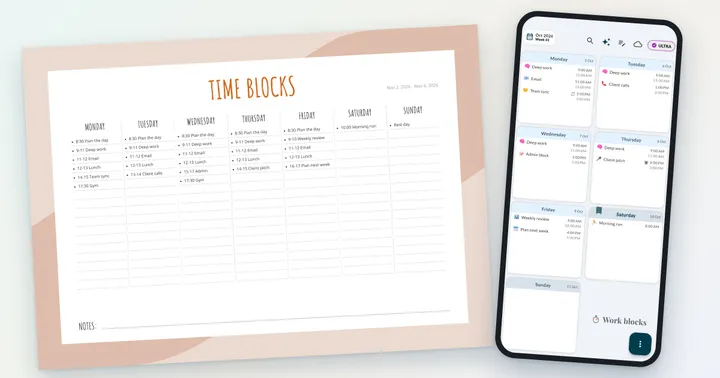
The page is the Weeklo “Week at a Glance” template: one wide row per day, with room for three study blocks and their time ranges. The dates are already printed, Monday to Sunday, so you can mark your exam days and count back.

| File | A4 | US Letter |
|---|---|---|
| Example week (the 4-weeks-out plan above, 2–8 Nov 2026) | Download PDF | Download PDF |
| Blank, Nov 2026 to Jan 2027 (9 weeks) | Download PDF | Download PDF |
| Blank, Jan to Jun 2027 (26 weeks) | Download PDF | Download PDF |
Free for personal use, no email required. The Weeklo app exports A4 (PDF export is PRO); the US Letter files are made by us with the same template. The app’s PDF shows your tasks but not their start and end times, so type the time into the task title before you print, as in the example page.

How to use it:
- Write the time range first, then the subject and the job: “9–11 Physics: forces, notes plus questions”.
- Circle the exam days where they fall, so the countdown is visible.
- Highlight past paper blocks in one colour. You see at a glance whether the week has enough of them.
- Use a pencil for the afternoon blocks. They move more than the morning ones.
- Keep Friday for the weekly review and Saturday morning for the buffer block.

Want a different look? The same dates come in five more designs in our printable weekly planner collection, and the week at a glance post shows how to use this layout for the rest of your life around exams.

Make your study schedule in Weeklo
Paper is easy to start. A planner app is easier to change when a block moves. In Weeklo:
- Make one planner for your exams and add an emoji to its name, such as “📚 Finals study”. Multiple planners are PRO.
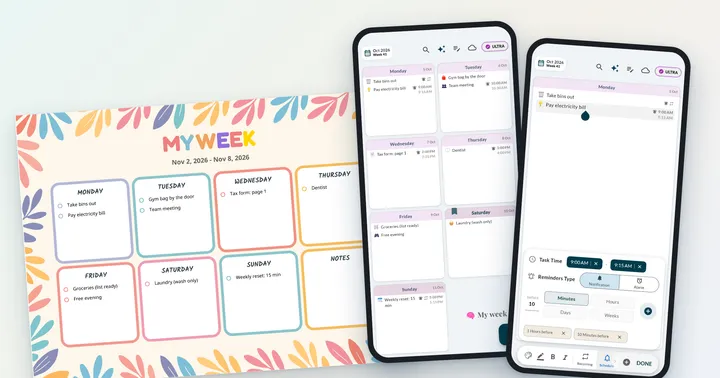
- Add each block as a task with a start and end time (PRO). Weeklo shows the times on the right of the task and sorts each day by start time, so the week reads like a timetable.
- Set a reminder (PRO) so your phone tells you when a block starts, and make the Friday review a recurring task (PRO) so it appears every week.
- Drag a block to another day when plans change. That is free, and it makes the re-plan above quick.
- Tick blocks off as you finish them. Completed tasks move to the bottom of the day.

For the method behind the blocks, read time block planning. For the Friday review and how to plan a whole week, see how to plan your week.
Start with step 1 today: write your exam dates at the top of a page and count the weeks.
Frequently asked questions
How do I make a study schedule for exams?
Write down your exam dates, list the topics in each subject, block your fixed commitments, then fill the free time with study blocks that each have one job, such as "Physics: forces, notes plus questions". Add one buffer block and a rest day every week, and review the plan once a week.
What is the best study schedule for exams?
The best schedule is one you can keep for the whole period. A plan works well when it covers all topics early, moves to timed past papers in the last two or three weeks, and leave gaps for things that run over. Two or three blocks a day, with breaks between them, is a realistic start.
How far ahead should I start a final exam study schedule?
As early as you can, because spreading study over more days leaves room for repeats. Even a short plan helps: the University of Pittsburgh Study Lab suggests a seven-day plan that begins 7 to 10 days before the test. For several subjects, 4 to 8 weeks gives you time to cover every topic once and still practise.
What should a study plan for finals include?
It should include every exam date, a list of topics per subject, dated study blocks, time for practice questions or past papers, a buffer for catching up, and a rest day. Put the last week on the plan too, with short recall sessions and a reminder to check the exam time and place.
What should I do if I fall behind on my study schedule?
Count the blocks you still have before each exam, then rank the missed topics by exam date and how weak you are on them. Keep the learning blocks, merge duplicate ones, move practice blocks to next week and use your buffer time. Rewrite the week instead of adding extra hours at night.